
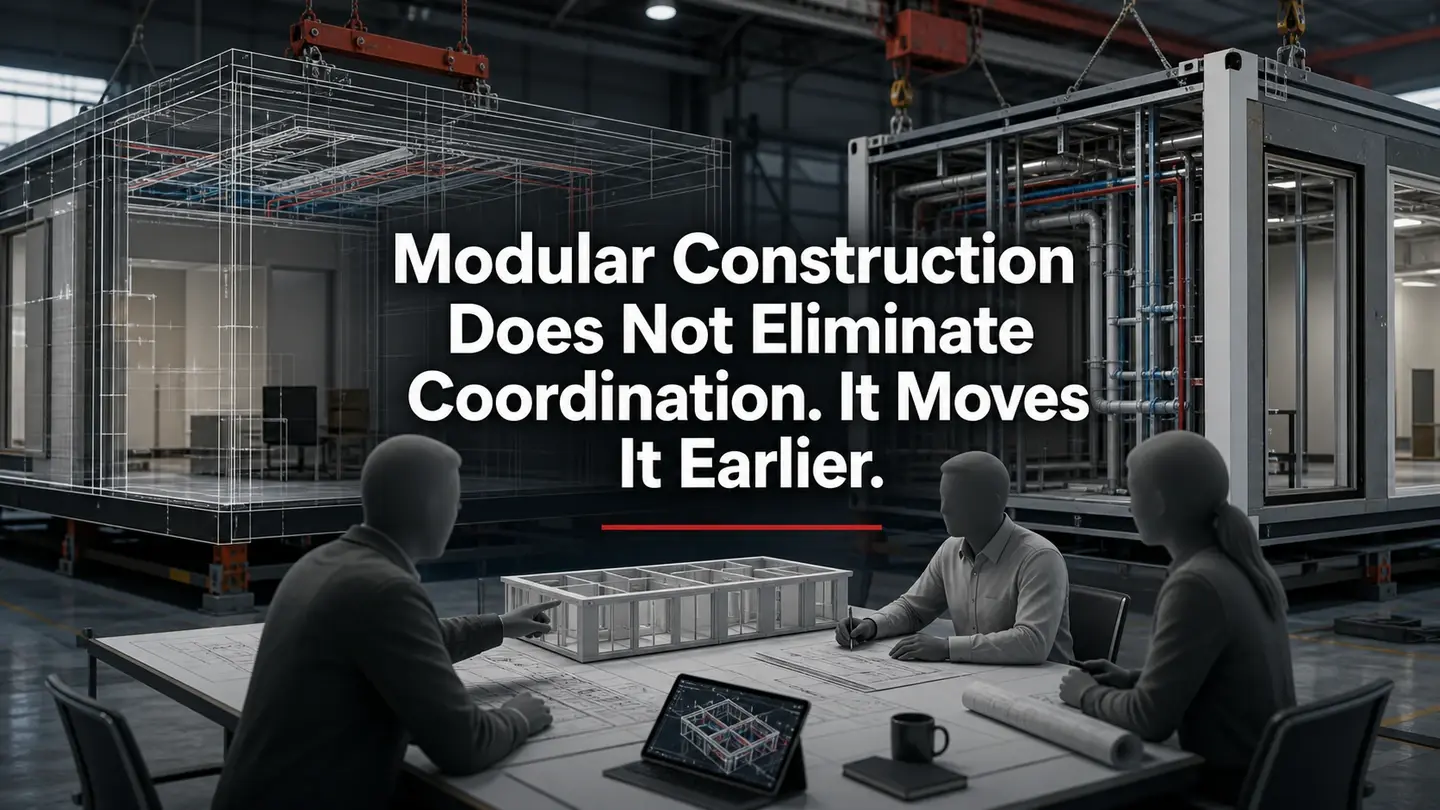
Modular Construction Does Not Eliminate Coordination. It Moves It Earlier.

The field schedule gets shorter because the decision schedule gets earlier
Modular construction coordination does not remove design decisions.
It changes when those decisions must be closed.
In conventional construction, a team may carry an unresolved routing or detail for another week.
In modular work, that same delay can stop fabrication.
The factory does not wait for design development to catch up.
Design freeze is not a single date
A modular project needs a series of controlled approval gates.
Module geometry may be ready while penetrations are not.
Structure may be approved while service zones are still moving.
The architectural layout may be settled while transport limits change the assembly.
Calling all of this a single design freeze hides the real work.
The team needs to know exactly what is frozen, who approved it, and what remains open.
The coordination table must be bigger
The modular manufacturer cannot be brought in after the model is already mature.
The architect, structural engineer, MEP trades, general contractor, manufacturer, logistics team, and installer need to resolve the same physical problem together.
That includes:
Module dimensions and structural connection points.
MEP service zones, risers, and field joints.
Penetrations, sleeves, embeds, and access clearances.
Fabrication and installation tolerances.
Lifting points and temporary bracing.
Shipping dimensions, route restrictions, and protection.
Factory testing, site testing, and commissioning sequence.
Installation order and temporary service requirements.
If one of these decisions is deferred, the risk does not disappear.
It moves into the factory or the field.
BIM must manage approvals, not only geometry
The model should show more than whether two objects clash.
It should show which geometry is approved for fabrication, which connection is pending, which tolerance has been accepted, and which change is too late to absorb without cost.
That requires issue ownership, decision dates, approval status, and version control.
A coordinated model without an approval process is still an uncertain model.
Late changes become manufactured rework
Modular construction can shorten the field schedule.
It can improve quality and move work into a controlled environment.
But weak early coordination does not eliminate rework.
It manufactures the rework sooner.
A late client change may affect a module already in production.
A missed connection may repeat across every unit.
A transport assumption may invalidate an otherwise coordinated design.
Final thought
Modular delivery rewards teams that make decisions early, document them clearly, and protect them from uncontrolled change.
The schedule advantage is real.
So is the coordination obligation that creates it.
Do not ask whether modular construction requires less coordination.
Ask whether the project is ready to coordinate earlier.
If you want BIM to create measurable project value, let’s build better, together.


Comments